Hypnotherapy for weight loss: your guide to one-to-one sessions

TL;DR:
- Personalized, therapist-led hypnotherapy effectively addresses psychological weight gain triggers more than prerecorded programs.
- In-person or online sessions with a qualified, PSA-registered practitioner combine techniques like CBT and NLP to support lasting change.
If you are searching for clinical hypnotherapy for weight management, the clearest recommendation is this: book a one-to-one session with a qualified therapist, not a prerecorded audio programme. The phrase “hypnotherapy CD for weight loss” circulates widely online, but what actually produces results is personalised, therapist-led clinical hypnotherapy — guided by someone who can assess your history, tailor suggestions to your specific patterns, and adjust the approach as you progress.
The most direct next step is to contact Resetyourmojo in Grantham for an in-person consultation, or arrange an online session if you are elsewhere in the UK. Before you call, have a brief summary of your goals and two or three available time slots ready.
This suits you if:
- You have habit-based overeating, emotional eating, or motivation barriers you have not been able to shift through willpower alone
- You are open to a psychological approach that works alongside dietary and lifestyle changes
- You want a qualified, insured practitioner rather than a generic audio download
Three checks before you book anyone:
- Verify PSA-accredited register listing
- Confirm DBS check and professional indemnity insurance
- Ask for transparent, written pricing before the first session
Table of Contents
- What is therapist-led clinical hypnotherapy for weight management?
- Who is a good candidate, and when should you see a GP first?
- What does a typical course of sessions look like?
- What does the evidence say, and is it available on the NHS?
- How do you choose a qualified UK hypnotherapist?
- Costs, booking logistics, and Grantham vs online
- Key takeaways
- Why the “just listen to something” approach misses the point
- Ready to book a session with Resetyourmojo?
What is therapist-led clinical hypnotherapy for weight management?
Clinical hypnotherapy for weight management is a structured, one-to-one treatment in which a trained practitioner guides you into a state of focused relaxation and uses evidence-based therapeutic techniques to address the psychological drivers of weight gain. Crucially, you remain fully awake, aware, and in control throughout; the Royal College of Psychiatrists describes the hypnotic state as focused relaxation rather than unconsciousness.

This is categorically different from a prerecorded audio programme. A therapist conducts a proper assessment, screens for contraindications, and builds suggestions around your specific history. A recording cannot do any of that.
In clinical practice, hypnotherapy rarely stands alone. Practitioners commonly integrate:
- Cognitive behavioural therapy (CBT): to identify and reframe unhelpful thought patterns around food and body image
- Neuro-linguistic programming (NLP): to shift habitual responses and build new behavioural anchors
- Person-centred counselling: to address emotional eating, self-esteem, and motivation at a deeper level
Experts recommend hypnotherapy as a support tool that reinforces dietary and activity changes rather than replacing them.
Who is a good candidate, and when should you see a GP first?
People who tend to benefit most from therapist-led hypnotherapy for weight management share a few common traits: habit-based or emotional eating patterns, difficulty sustaining motivation, or a history of starting well and then reverting. If the barrier is psychological rather than purely physiological, hypnotherapy has a clear role.
That said, some situations require a GP conversation before booking a hypnotherapy session.
See your GP first if you:
- Have a BMI at an extreme (very high or very low) that may require medical management
- Are on medication that affects appetite, metabolism, or mood
- Have any signs of an eating disorder (restriction, purging, binge-eating disorder)
- Have an unstable mental-health condition such as active psychosis or suicidal ideation
- Are pregnant or have a significant unmanaged physical health condition
Hypnotherapy is generally non-invasive and safe when conducted by a trained practitioner, though it can cause transient drowsiness or emotional responses in some clients. Where you are already working with a GP, dietitian, or mental-health professional, a good hypnotherapist will liaise with that team rather than work in isolation.
What does a typical course of sessions look like?
The initial consultation
The first appointment covers your goals, relevant medical history, current relationship with food, and suitability for hypnotherapy. This is not a formality; it shapes every subsequent session.
A typical course
- Sessions 1–2: Establishing rapport, introducing hypnotic induction, and beginning work on motivation and self-image
- Sessions 3–5: Targeted suggestion work — cravings management, visualisation of healthy habits, and addressing emotional triggers
- Mid-course review: Assessing progress, adjusting the approach, and introducing self-practice techniques
- Final sessions: Consolidating gains, building self-reliance, and agreeing a follow-up plan
Sessions typically last 30–60 minutes, with most courses running across six to eight appointments. Frequency is usually weekly or fortnightly.
Between sessions
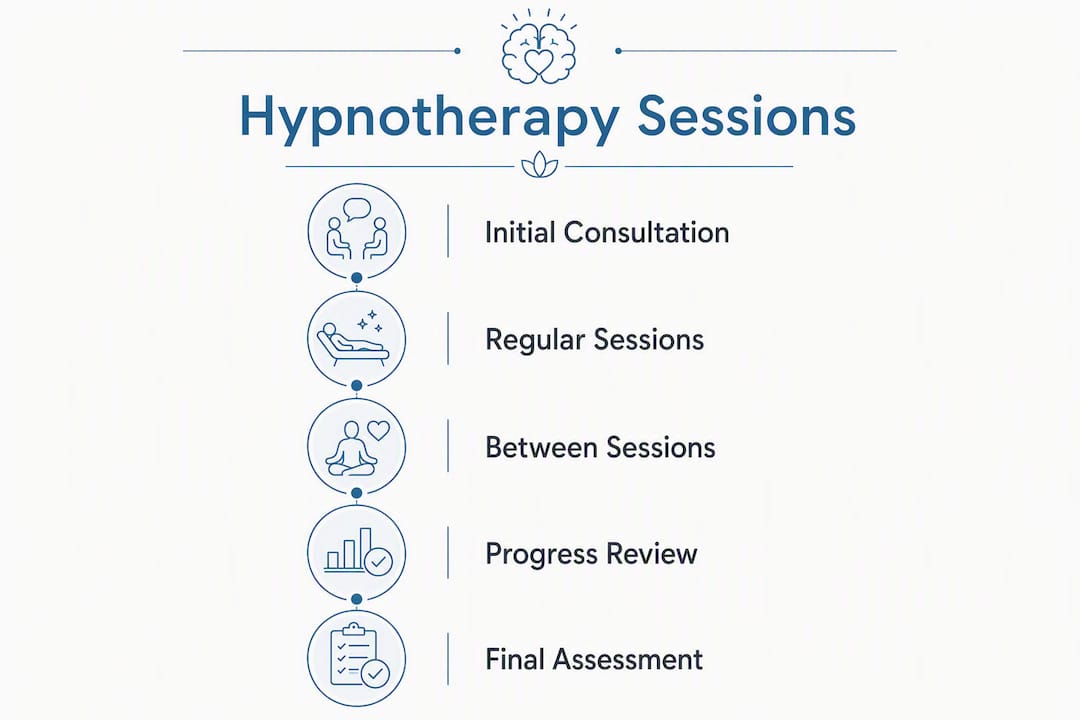
Aftercare matters as much as the sessions themselves. Your therapist may provide a short personalised audio summary, a CBT-style thought record, or simple lifestyle goals to practise between appointments. Trials consistently show better outcomes for people who practise self-hypnosis regularly alongside their therapist sessions.
Pro Tip: Keep your between-session practice short and consistent — ten minutes daily outperforms a single long session once a week. Pair it with a concrete behavioural goal (a specific meal change, a short walk) rather than treating it as passive relaxation.
What does the evidence say, and is it available on the NHS?
The evidence is promising but not definitive. Systematic reviews and meta-analyses indicate hypnosis can support short-term weight loss, and results tend to be stronger when hypnotherapy is combined with CBT. One study found that combining the two produced superior outcomes for 66% of participants compared with CBT alone. Long-term evidence remains limited, and some pilots found no significant difference between relaxation hypnotherapy and other structured psychological approaches, which points to variability between protocols and individual responsiveness.Clinical hypnotherapy is not routinely available on the NHS for weight management; most people access it privately. That makes practitioner quality checks all the more important.
Safety checklist:
- Hypnotherapy is non-invasive when delivered by a trained, registered practitioner
- Possible transient effects: drowsiness, emotional responses, vivid imagery
- Not suitable for active psychosis, certain dissociative conditions, or severe untreated depression without prior clinical clearance
- Always confirm DBS check, professional indemnity insurance, and formal clinical training before booking
This article is general information, not medical advice. Confirm your suitability with your GP or a qualified clinician before starting any new treatment.
How do you choose a qualified UK hypnotherapist?
The Royal College of Psychiatrists is clear: check PSA-accredited registers. Hypnotherapy is not a statutorily regulated profession in the UK, so the register check is your primary safeguard.
Checklist before you book:
- Listed on a PSA-accredited register (e.g. the Complementary and Natural Healthcare Council or the National Hypnotherapy Society)
- Current DBS certificate and professional indemnity insurance
- Formal training in clinical hypnotherapy (not a weekend certificate)
- Demonstrable experience with weight management specifically
- Written pricing and a clear cancellation policy
Questions to ask at first contact:
- Where did you train, and how long was the course?
- Are you listed on a PSA-accredited register?
- How do you integrate CBT or NLP into weight-management work?
- How many sessions do you typically recommend, and how do you measure progress?
- What is your cancellation and refund policy?
Red flags: guaranteed weight-loss claims, pressure to buy a large pre-paid package upfront, vague or evasive answers about qualifications, no mention of a clinical assessment.
Pro Tip: Ask for a brief 10–15 minute assessment call before committing. It tells you whether the therapist listens, whether they use evidence-based methods, and whether you feel comfortable enough to do the actual work.
Costs, booking logistics, and Grantham vs online
Session fees vary by practitioner, location, and experience. Sliding-scale and concession rates are available from some practices, including Resetyourmojo, making access more equitable regardless of financial circumstances.In-person (Grantham)Online (UK-wide)FormatFace-to-face clinic sessionVideo call (Zoom or equivalent)AccessibilityLocal to Grantham and surrounding areaAvailable anywhere in the UKRapportDirect physical presenceStrong with a good practitioner; slightly different dynamicTechnology neededNoneStable internet, camera, quiet private spaceConfidentialityPrivate clinic roomClient responsible for private environmentSliding scaleAvailable at ResetyourmojoAvailable at Resetyourmojo
For online sessions, you will need to review and sign a telehealth consent form covering data handling, session recording policy, and emergency protocols before your first appointment.
Before your first appointment, have ready:
- A brief note on your weight-management goals and history
- A list of current medications
- Your GP’s name (in case liaison is needed)
- Realistic expectations: hypnotherapy supports change, it does not create it without your active participation
Key takeaways
Therapist-led clinical hypnotherapy for weight management works best as a personalised, PSA-registered, one-to-one treatment integrated with CBT and lifestyle change — not as a passive audio experience.PointDetailsOne-to-one beats prerecorded audioA qualified therapist assesses, screens, and tailors suggestions in ways no recording can replicate.CBT integration strengthens resultsOne study found 66% superior outcomes when hypnotherapy was combined with CBT versus CBT alone.PSA register is your safeguardHypnotherapy is unregulated in the UK; always verify PSA-accredited registration before booking.Home practice predicts outcomesTrials show better results for clients who practise self-hypnosis regularly between sessions.Resetyourmojo offers both formatsIn-person sessions in Grantham and online appointments UK-wide, with a sliding-scale pricing model.
Why the “just listen to something” approach misses the point
The most common misconception about hypnotherapy for weight management is that the hypnosis itself is the active ingredient. It is not. The hypnotic state is a vehicle; what matters is what a skilled therapist does with it once you are there.
Weight management is rarely about information. Most people know what they should eat. The real work is in the emotional patterns, the habitual responses, the self-talk that kicks in at 9pm. A therapist who has assessed those patterns specifically, and who adjusts their approach when something is not landing, is doing something qualitatively different from a generic recording.
The Royal College guidance on building client self-reliance is worth taking seriously too. The goal of good hypnotherapy is not to create a dependency on sessions; it is to give you tools you can use independently. Practitioners who measure outcomes, schedule follow-ups, and teach self-practice are working toward that end. Those who sell indefinite packages without clear milestones are not.
Resetyourmojo’s personalised support plans are built around exactly this principle: structured progress, clear goals, and a defined endpoint rather than open-ended attendance.
Ready to book a session with Resetyourmojo?
Resetyourmojo offers something most private hypnotherapy practices do not: genuine accessibility alongside clinical rigour. The sliding-scale pricing model means cost is not an automatic barrier, and the practice is explicitly welcoming to neurodivergent and LGBTQ+ clients.

For weight management, the service covers an initial clinical assessment, bespoke one-to-one hypnotherapy sessions integrating CBT and NLP, and structured follow-up support. Sessions are available in person at the Grantham wellbeing hub or online across the UK. If you want to explore complementary approaches alongside hypnotherapy, life coaching and NLP sessions are also available.
To book your first assessment, visit the hypnotherapy services page, choose in-person or online, and bring a brief summary of your goals to the call. Concession rates are available on request.
Useful sources
SourceWhy it is usefulRoyal College of Psychiatrists: Hypnosis and hypnotherapyPrimary UK clinical guidance on hypnotherapy safety, PSA registers, and practitioner standardsMedical News Today: Is hypnosis beneficial for weight loss?Accessible summary of meta-analyses and RCT evidence on hypnosis for weight managementNICE: Overweight and obesity managementUK clinical guideline on behavioural interventions for weight management, including goal-setting and reviewResetyourmojo hypnotherapy servicesBooking page for in-person Grantham and UK-wide online hypnotherapy sessions