Role of Control in Hypnotherapy
Feeling overwhelmed by stress or anxiety can leave you searching for answers that put you back in charge of your own mind. For many in Grantham, hypnotherapy offers a fresh path toward self-control—not the mind control myths, but real skills for managing your thoughts and emotions. Modern techniques focus on empowering you through collaboration and self-regulation, helping you regain balance and build genuine confidence in your mental wellbeing.
Table of Contents
- Defining Control In Modern Hypnotherapy
- What Control Actually Means In Your Session
- Common Myths And Clinical Realities
- Myths That Hold People Back
- How Control Empowers Client Wellbeing
- Protocols, Safety, And Therapist Collaboration
- Applying Control Strategies For Anxiety Relief
Key Takeaways
Point
Details
Definition of Control
Modern hypnotherapy is about gaining self-control, enabling clients to regulate their own behaviour and responses.
Patient-Centred Approach
Therapists collaborate with clients, ensuring they are active participants in their healing journey.
Common Myths
Hypnotherapy is often misunderstood as mind control; in reality, it requires patient cooperation and is grounded in clinical evidence.
Empowerment through Techniques
Clients learn specific control strategies to manage anxiety, promoting autonomy and long-term wellbeing.
Defining Control in Modern Hypnotherapy
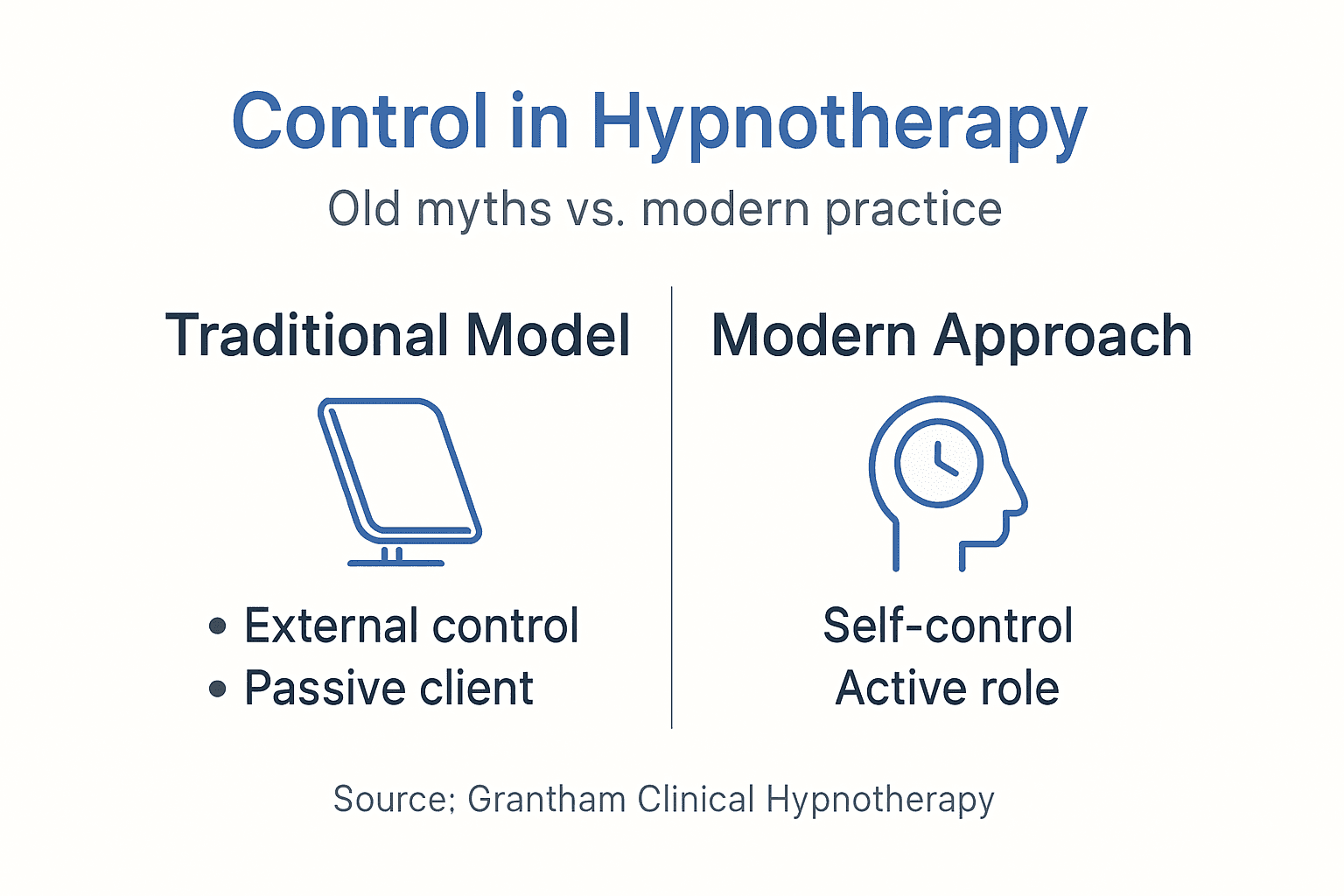
Control in modern hypnotherapy means something very different from what most people imagine. You’re not being controlled by a hypnotist swinging a pocket watch. Instead, you’re gaining self-control—the ability to regulate your own behaviour, emotions, and physical responses.
Clinical hypnosis involves focused attention paired with an increased responsiveness to suggestion. This isn’t about someone else pulling strings. You’re the one in charge, directing your mind towards the changes you want to make.
The shift to patient-centred approaches has transformed hypnotherapy entirely. Modern practitioners work alongside you, not over you. You’re an active participant in your own healing, not a passive recipient of treatment.
Here is a comparison of traditional versus modern hypnotherapy approaches to control:
Aspect of Control
Traditional Hypnotherapy
Modern Hypnotherapy
Practitioner Role
Authority figure giving commands
Collaborative guide supporting self-direction
Patient Involvement
Passive, following suggestions
Active, shaping and choosing goals
Approach to Autonomy
Limited, therapist-centred
Full, patient-centred
Flexibility
Standardised scripts and routines
Technique tailored to individual needs
What Control Actually Means in Your Session
Modern hypnotherapy emphasises self-regulation rather than therapist authority. Your therapist acts as a guide, not a director issuing commands. This collaborative approach respects your autonomy and builds genuine therapeutic change from within.
Control in this context includes:
- The ability to enter and exit hypnotic states at will
- Complete awareness of what’s happening during sessions
- Freedom to accept or reject suggestions that don’t align with your values
- Active involvement in designing your treatment plan
- The power to pause or stop any technique whenever you choose
Many people in Grantham come to hypnotherapy feeling overwhelmed by anxiety or stress. They’ve lost control of their thoughts, their sleep, their reactions. Modern hypnotherapy helps you reclaim that control by working with your mind rather than against it.
You remain fully conscious throughout. You’re never unconscious, asleep, or unaware. Your therapist’s voice might become background noise as you focus inward, but you’re directing your own internal experience.
Control in modern hypnotherapy is about self-empowerment, not surrender. You’re learning to manage your own mind more effectively.
This patient-centred philosophy means your therapist listens to your goals and concerns before suggesting any approach. They adapt techniques to suit your preferences, personality, and what actually works for you. No two hypnotherapy experiences are identical.
Pro tip: During your first session, discuss your concerns about control openly with your therapist. Knowing you can pause or adjust techniques at any moment often makes the experience feel more comfortable and effective.
Common Myths and Clinical Realities
Hypnotherapy has picked up a lot of baggage over the years. Hollywood images of swinging pocket watches and blank-eyed subjects dominate popular culture. The reality is far less dramatic and far more useful.
The biggest myth? That hypnosis is mind control. People worry they’ll lose their free will or be forced to do things against their values. This couldn’t be further from the truth. Hypnosis requires patient cooperation and active participation. You can’t be hypnotised against your will, and you can’t be made to do anything that contradicts your core beliefs.
Another common misconception is that hypnotherapy lacks scientific backing. Some people dismiss it as pseudoscience or entertainment trickery. In reality, clinical evidence supports hypnosis as a structured psychotherapeutic tool with proven efficacy for various psychological and psychiatric conditions.
Myths That Hold People Back
Here are the persistent myths keeping people in Grantham from exploring hypnotherapy:
- “I’ll get stuck in hypnosis.” You can exit hypnotic states whenever you choose. Your mind won’t abandon you.
- “The hypnotist controls my thoughts.” You remain in control. Suggestions work only if you accept them.
- “I’ll reveal secrets against my will.” Hypnosis doesn’t unlock hidden confessions. You maintain your privacy.
- “Only weak-minded people respond to hypnosis.” Responsiveness has nothing to do with intelligence or strength.
- “Hypnotherapy is just relaxation.” It’s far more targeted and structured than simply feeling calm.
The clinical reality is straightforward. Hypnotherapy uses focused attention and heightened suggestibility to access your unconscious mind productively. Your therapist acts as a collaborator, helping you restructure unhelpful patterns and build new responses to situations that previously triggered anxiety or stress.
To clarify essential clinical distinctions, here is a summary of myths versus realities in hypnotherapy:
Common Myth
Clinical Reality
Hypnosis removes free will
Personal autonomy is always maintained
It is only entertainment
Supported by scientific research
Hypnotist has full control
Patient retains ultimate authority
Only some can benefit
Most people can respond if willing
Used for relaxation only
Effective for targeted psychological change
This means real change happens through your own mental processes, not external manipulation. You’re learning to manage your mind more effectively—that’s the opposite of losing control.
Evidence-based hypnotherapy is a credible therapeutic tool, not entertainment or pseudoscience. It works because you actively participate in your own healing.
When you understand what hypnotherapy actually is, scepticism often transforms into genuine interest. People realise they’re not surrendering anything. They’re gaining a practical skill for managing their own mind.
Pro tip: Ask your therapist to explain exactly how hypnosis works and what you’ll experience before your session begins. Understanding the process dissolves most remaining worries and helps you engage more fully.
How Control Empowers Client Wellbeing
Control isn’t just about freedom—it’s the foundation of genuine healing. When you feel in control during hypnotherapy, something shifts psychologically. You’re no longer a passive observer of your own mind. You become an active agent directing your own recovery.
Control mechanisms in hypnotherapy enhance self-efficacy and support your active role in the healing journey. This isn’t subtle or incidental. It directly affects how well the therapy works and how long the improvements last.

When you manage your own focus and responses to suggestions, you’re essentially rewiring your own nervous system. You’re teaching your mind new patterns instead of having them imposed on you. That distinction matters enormously for sustainable change.
The Real Power of Therapeutic Control
Engaging client control enables management of physiological and emotional states, leading to improved outcomes across stress reduction, pain management, and behaviour change. You’re not just feeling better temporarily. You’re developing genuine psychological resilience.
Here’s what control creates in your wellbeing:
- Greater confidence in managing anxiety when it arises
- Reduced dependency on external solutions or quick fixes
- Ability to access calming techniques independently between sessions
- Deeper trust in your own mind and its capacity for change
- Sustained improvements because change comes from within you
Many people in Grantham experience anxiety or stress that leaves them feeling helpless. Hypnotherapy restores agency. You realise you’re not broken. You’re simply working with your mind more effectively than before.
When you direct your own focus during hypnosis, your brain responds differently than if someone else were controlling the narrative. Your unconscious mind recognises that you’re participating willingly. This collaboration creates stronger neural pathways and more durable behaviour change.
Control also reduces the risk of relapse. Because you’ve been actively involved in creating change, you understand how to maintain it. You’re not dependent on returning to a therapist indefinitely. You’ve gained a skill you carry with you.
Control in hypnotherapy transforms you from someone receiving treatment into someone actively directing their own recovery. That shift is where real, lasting wellbeing begins.
Clients who feel genuinely in control report higher satisfaction with treatment. They also experience better long-term outcomes. The empowerment extends beyond symptom relief into genuine confidence and self-trust.
Many clients tell us they appreciate seeing real feedback from others who’ve experienced this transformation firsthand.
Pro tip: Before each hypnotherapy session, remind yourself that you’re in control of your experience. You can pause, adjust, or stop anything that doesn’t feel right. This mindset alone enhances the therapeutic benefit significantly.
Protocols, Safety, and Therapist Collaboration
Professional hypnotherapy isn’t a casual chat. It follows strict protocols designed to keep you safe and make the therapy effective. Your therapist works within an established framework that prioritises your wellbeing at every step.
Safety begins before your first session. Modern hypnotherapy protocols emphasise informed consent and clear communication between therapist and client. You’ll discuss your medical history, current concerns, and treatment goals. Nothing happens without your explicit agreement.
Your therapist explains exactly what hypnosis involves and what you’ll experience. This transparency builds trust. You’re making an informed choice about your own care, not entering something mysterious or unpredictable.
How Therapists Maintain Safety Throughout Treatment
Therapist collaboration requires thorough assessment, consent, and adaptation to individual needs. This isn’t a one-size-fits-all approach. Your therapist adjusts techniques based on how you respond and what works best for you.
During sessions, your therapist maintains vigilance for any adverse reactions or discomfort. They’re monitoring your physical responses, listening carefully to your feedback, and staying ready to adjust the approach if needed. This active attention protects you throughout the process.
Key safety practices include:
- Screening for contraindications or medical conditions that require special care
- Establishing clear boundaries and expectations before treatment begins
- Using standardised induction procedures that have been tested and refined
- Maintaining continuous communication about how you’re experiencing the process
- Respecting your autonomy to pause, adjust, or decline any technique
- Keeping detailed records and following ethical guidelines throughout treatment
In Grantham, Reset Your Mojo therapists follow evidence-based protocols and maintain professional accreditation. Your safety and ethical care aren’t optional. They’re foundational to every session.
Collaboration means your therapist isn’t working on you—they’re working with you. You’re partners in the therapeutic process. Your therapist brings clinical expertise and training. You bring knowledge of your own mind, values, and what matters to you. Together, you create change more effectively than either could alone.
Professional protocols and genuine collaboration create the conditions where real healing happens safely. Your therapist’s commitment to safety is a sign of their professional integrity.
Before starting treatment, your therapist should provide written information about their qualifications, approach, and what to expect. They should be happy to answer any questions about safety, protocols, or their experience with conditions like yours.
Pro tip: Write down any concerns or questions before your first appointment and discuss them openly. A good therapist welcomes these conversations because transparency strengthens the therapeutic relationship and makes treatment more effective.
Applying Control Strategies for Anxiety Relief
Anxiety often feels like something happening to you, beyond your control. Your heart races. Your mind spirals. Your body tenses. Hypnotherapy teaches you to flip that dynamic. You learn practical control strategies that work with your nervous system, not against it.
Hypnotherapy employs control strategies such as focused attention, relaxation techniques, and guided imagery to help you regulate anxiety symptoms. These aren’t vague meditation tips. They’re specific, learnable techniques that give you real mastery over your anxiety triggers.
During sessions, your therapist guides you through these strategies step by step. You practise them in a safe, controlled environment where anxiety can’t escalate unexpectedly. This builds confidence that you can actually manage these responses.
Key Control Strategies You’ll Learn
Effective application includes progressive relaxation, deepening hypnotic states, and personalised suggestion frameworks that empower you to manage anxiety proactively. Here’s what you’ll work with:
- Focused attention techniques that redirect anxious thoughts toward calming, present-moment awareness
- Progressive relaxation that teaches your body to release tension systematically
- Guided imagery using vivid mental scenes that naturally soothe your nervous system
- Personalised suggestions tailored to your specific anxiety patterns and triggers
- Resource anchoring linking physical sensations or words to feelings of calm and control
Many people in Grantham find anxiety management most effective when they can access these techniques independently. Your therapist teaches you self-hypnosis so you’re not dependent on sessions to regulate anxiety. You become your own resource.
The beauty of these strategies is that they enhance your coping skills whilst preserving your autonomy. You’re not suppressing anxiety or ignoring it. You’re developing genuine mastery over your stress responses. Your nervous system learns new patterns through repetition and practice.
As you practise between sessions, anxiety typically becomes less intense and less frequent. Triggers that previously spiralled into panic become manageable. You notice yourself responding differently before anxiety even builds.
Control strategies in hypnotherapy work because they teach your nervous system new responses. Real anxiety relief comes from changing how your body reacts, not just changing your thoughts.
Each strategy builds on the previous one, creating layers of protection against anxiety. By the end of treatment, you’ve developed a toolkit you carry with you. Anxiety may return occasionally, but you’ll know exactly how to manage it.
Pro tip: Practice your hypnotherapy techniques consistently between sessions, even when anxiety feels manageable. Regular practice embeds these control strategies into your nervous system, making them automatic when you need them most.
Take Back Control and Regain Wellbeing with Expert Hypnotherapy
Modern hypnotherapy empowers you to reclaim self-control over anxiety, stress, and overwhelming emotions by working collaboratively with your mind. If you find yourself struggling to manage persistent anxiety or feel trapped by stress, understanding that you remain fully conscious and in charge during hypnotherapy can be deeply reassuring. At Reset Your Mojo, based in Grantham, we specialise in evidence-based clinical hypnotherapy tailored to your unique needs, emphasising patient-centred care and safety to build lasting change.
Discover how personalised techniques like focused attention, relaxation, and guided imagery can help you gain the confidence and skills to manage anxiety effectively in daily life. Do not let myths about hypnotherapy hold you back from this powerful self-empowerment. Visit Reset Your Mojo today and take the first step towards directing your own healing journey with professional support. Your wellbeing deserves the control and respect this approach provides.
Explore more about our comprehensive services and how control plays a pivotal role in your progress on our main site. If you want to understand what your sessions will involve, check out our detailed explanations available during your initial consultation.
Frequently Asked Questions
What does control mean in modern hypnotherapy?
Control in modern hypnotherapy refers to self-control and the ability to regulate your own behaviours, emotions, and physical responses during sessions, rather than being manipulated by the therapist.
How does hypnotherapy promote self-empowerment?
Hypnotherapy promotes self-empowerment by allowing clients to actively participate in their healing process, design their treatment plans, and make choices regarding the suggestions they accept or reject.
Can I really manage my anxiety through hypnotherapy?
Yes, hypnotherapy provides practical strategies to manage anxiety, such as focused attention, progressive relaxation, and guided imagery, which can be used to regulate anxiety triggers effectively.
What common myths about hypnotherapy should I be aware of?
Common myths include the belief that hypnosis is mind control, that it lacks scientific backing, and that only weak-minded people can be hypnotised. These myths undermine the collaborative and evidence-based nature of modern hypnotherapy.