Why quit smoking: health benefits and how to stop

Quitting smoking improves health immediately and reduces long-term disease risk significantly. Physical benefits begin within minutes and continue to improve over years, lowering the chances of cancer, heart disease, and stroke. Combining nicotine replacement therapy with behavioural support increases the likelihood of successfully quitting at any age.
Quitting smoking is the single most effective action you can take to improve your health at any age. Within 20 minutes of your last cigarette, your body begins to repair itself. Within years, your risk of cancer, heart disease, and stroke drops dramatically. The reasons to stop smoking are not abstract or distant. They are measurable, physiological, and they begin the moment you decide to quit. This article covers the immediate and long-term benefits of quitting smoking, the challenges you will face, and the strategies that genuinely work.
Why quit smoking: what happens to your body straight away?
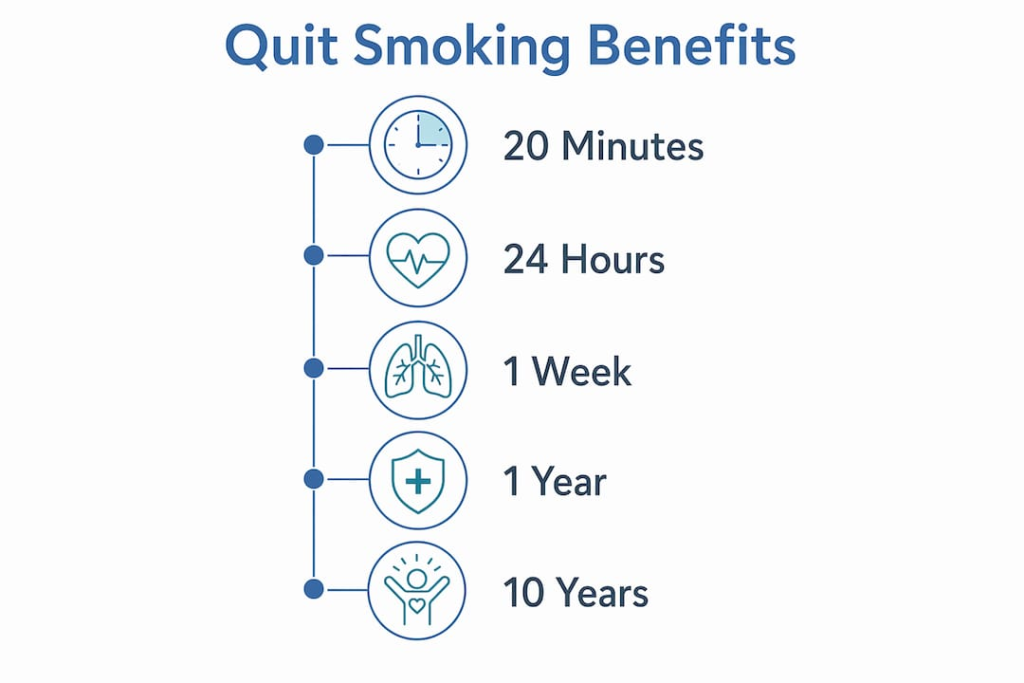
The body's response to quitting smoking begins faster than most people expect. Heart rate and blood pressure normalise within 20 minutes of stopping. That is not a long-term projection. It is a measurable change happening before you have even finished your first smoke-free hour.

Within 12 to 24 hours, carbon monoxide levels in your blood drop significantly. Carbon monoxide is the same gas found in car exhaust fumes. It competes with oxygen in your red blood cells, starving your organs of the fuel they need. Once it clears, your blood carries oxygen more efficiently, and your heart no longer has to work as hard.
The early days bring other changes too:
- Taste and smell begin to return within 48 hours as nerve endings start to regenerate.
- Lung function starts to improve as cilia, the tiny hair-like structures in your airways, begin clearing mucus and debris.
- Circulation improves noticeably within two to three weeks, making physical activity easier.
- Risk of heart attack begins to fall within the first 24 hours and continues to drop over the following months.
Pro Tip: Write down how you feel at 20 minutes, 24 hours, and one week after quitting. Tracking physical changes gives you concrete evidence that your body is responding, which strengthens your motivation to continue.
These early wins matter. They are not trivial. They are your body telling you, in biological terms, that the decision you made was the right one.
How does quitting smoking reduce long-term disease risk?
The long-term benefits of quitting smoking accumulate steadily over years. Risk reduction for several diseases begins shortly after quitting and continues to build, regardless of how long you smoked before stopping. That is a critical point. It is never too late.
The most significant long-term gains come in three areas: cardiovascular health, respiratory function, and cancer risk.Disease areaWhen risk reduction beginsLong-term outcomeHeart diseaseWithin 1 year of quittingRisk approaches that of a non-smoker after 15 yearsLung cancerWithin 10 yearsRisk roughly halves compared to continued smokingStrokeWithin 2–5 yearsRisk can fall to near non-smoker levelsCOPDImmediately after quittingDecline in lung function slows significantlyBladder and throat cancerWithin years of quittingRisk reduces progressively over time
Chronic obstructive pulmonary disease (COPD) deserves particular attention. Smoking is the leading cause of COPD, a condition that progressively destroys lung tissue. Quitting does not reverse existing damage, but it slows the decline sharply. People with COPD who quit report better breathing, fewer flare-ups, and improved quality of life within months.
Physical fitness also improves in ways that surprise many people. Stamina increases, recovery after exercise speeds up, and resting heart rate drops. These are not minor lifestyle perks. They represent a measurable shift in how your cardiovascular system functions day to day.
The evidence is clear: quitting at any age yields substantial health benefits. A 60-year-old who quits still gains years of improved health and reduced disease risk compared to someone who continues smoking.
What are the withdrawal symptoms when you stop smoking?
Withdrawal is real, and it is the main reason people struggle to quit. Understanding what to expect removes the shock and helps you plan.Nicotine withdrawal symptoms peak within the first few days and typically resolve within a few weeks. That timeline is shorter than most people assume. The discomfort feels permanent in the moment, but it is not.
Common withdrawal symptoms include:
- Anxiety and irritability, driven by the brain's adjustment to functioning without nicotine.
- Sleep disruption, including difficulty falling asleep and vivid dreams.
- Difficulty concentrating, which tends to peak in the first week.
- Increased appetite, which can lead to temporary weight gain for some people.
- Strong cravings, which usually last only 3 to 5 minutes each, even when they feel overwhelming.
Increased appetite and snacking are common during the early weeks. This is manageable with planning. Keeping healthy snacks available and staying hydrated reduces the impact significantly.
Pro Tip: When a craving hits, set a timer for five minutes and do something physical. Walk around the block, do ten press-ups, or drink a large glass of water. The craving will almost always have passed by the time the timer goes off.
Nicotine addiction rewires brain function over time. This means quitting is not simply a matter of willpower. It is a process of managing a physiological dependency, and treating it as such removes the self-blame that derails so many quit attempts.
What strategies actually work for quitting smoking?
The most effective approach to stopping smoking combines multiple methods rather than relying on willpower alone. Using patches, gum, or lozenges in combination significantly improves quit success rates compared to using a single method.
Here is a structured approach that reflects current best practice:
- Set a quit date. Choose a date within the next two weeks. Give yourself time to prepare without giving yourself time to procrastinate.
- Use nicotine replacement therapy (NRT). A long-acting patch provides a steady baseline of nicotine. Short-acting gum or lozenges handle sudden cravings. Combining a patch with gum or lozenges is more effective than either method alone.
- Build a personalised quit plan. Identify your smoking triggers. Common ones include coffee, alcohol, stress, and social occasions. A personalised support plan that addresses your specific triggers is far more effective than a generic approach.
- Tell people you are quitting. Social support is not optional. People who quit with support from friends, family, or a professional are significantly more likely to succeed.
- Use behavioural change techniques. Cognitive behavioural therapy (CBT) and neuro-linguistic programming (NLP) help you identify and change the thought patterns that drive smoking behaviour.
- Manage triggers long after withdrawal ends. Behavioural triggers like coffee or social settings can prompt cravings months after nicotine has left your system. Identifying and planning for these is a separate skill from managing withdrawal.
Multiple cessation methods used together, particularly combined NRT and counselling, produce the highest quit rates. No single method works for everyone. The goal is to find the combination that fits your life.
Does quitting smoking actually improve mental health?
The idea that smoking relieves stress is one of the most persistent myths in public health. Smoking does not reduce stress. It temporarily relieves the anxiety caused by nicotine withdrawal itself. Once you are no longer dependent on nicotine, that cycle ends.
Mental health and wellbeing improve after nicotine addiction ends. People who quit report lower levels of anxiety and depression compared to when they were smoking. Sleep quality improves, mood becomes more stable, and the constant background stress of managing an addiction disappears.
The mental health benefits of quitting smoking include:
- Reduced anxiety once the withdrawal phase passes, typically within a few weeks.
- Better sleep quality, as nicotine disrupts sleep architecture even when smokers do not realise it.
- Improved mood stability, with fewer sharp emotional swings tied to craving cycles.
- Greater sense of control, which has a measurable positive effect on self-esteem and confidence.
Pro Tip: If anxiety spikes during withdrawal, practise box breathing: inhale for four counts, hold for four, exhale for four, hold for four. This activates the parasympathetic nervous system and reduces acute anxiety within minutes.
The mental shift after quitting is often the part people did not expect. Many describe feeling calmer, clearer, and more in control than they had in years. That is not a coincidence. It is what life without nicotine dependency actually feels like.
Key takeaways
Quitting smoking delivers measurable health benefits within minutes of stopping, and those benefits accumulate steadily over years, reducing the risk of cancer, heart disease, and respiratory illness at every stage of life.PointDetailsImmediate physical changesHeart rate and blood pressure normalise within 20 minutes of quitting.Long-term disease riskRisk of heart disease, lung cancer, and stroke drops significantly within years of stopping.Withdrawal is temporarySymptoms peak in the first few days and typically resolve within a few weeks.Combined methods work bestPairing nicotine replacement therapy with behavioural support produces the highest success rates.Mental health improvesAnxiety and depression reduce once nicotine dependency ends, disproving the stress-relief myth.
What I have learned from working with people who quit smoking
The most common thing people say when they first come to me is that they have already tried to quit and failed. My response is always the same: that is not failure. Each attempt is progress towards final success. Every quit attempt teaches you something about your triggers, your patterns, and what support you actually need.
What I have seen consistently is that people who treat quitting as a single act of willpower struggle far more than those who treat it as a process. Nicotine addiction is physiological. It changes brain chemistry. Expecting to overcome it through determination alone is like expecting to recover from a broken leg through positive thinking.
The people who succeed are the ones who build a structure around their quit attempt. They use NRT, they tell people they are stopping, they identify their triggers, and they get professional support when they need it. They also give themselves permission to find it hard without interpreting difficulty as defeat.
What surprises people most is the mental health shift. They expected to feel better physically. They did not expect to feel calmer, more confident, and more like themselves than they had in years. That transformation is real, and it is available to anyone who commits to the process with the right support around them.
— Jo
Professional support for stopping smoking in Grantham and online
Stopping smoking is one of the most significant health decisions you can make, and you do not have to navigate it alone.
Resetyourmojo offers hypnotherapy for smoking cessation in Grantham and online across the UK, combining clinical hypnotherapy with NLP and CBT techniques to address both the physical habit and the psychological patterns that keep people smoking. Sessions are tailored to your specific triggers, lifestyle, and motivation, giving you a structured quit plan rather than a generic programme. For those who want to work on the broader habits and mindset around quitting, life coaching and NLP services are also available. If you are ready to take the next step, Resetyourmojo is here to help you build a quit plan that actually fits your life.
FAQ
How quickly does your body recover after quitting smoking?
Recovery begins within 20 minutes of your last cigarette, when heart rate and blood pressure start to normalise. Over months and years, the risk of heart disease, cancer, and stroke drops significantly.
What are the hardest withdrawal symptoms to manage?
Anxiety, irritability, and sleep disruption are the most commonly reported challenges. These symptoms typically peak in the first few days and resolve within a few weeks for most people.
Does quitting smoking help with anxiety and stress?
Quitting smoking reduces anxiety and depression once the withdrawal phase passes. Smoking does not relieve stress; it temporarily relieves the anxiety caused by nicotine withdrawal itself.
Is it too late to quit smoking if you have smoked for decades?
Quitting at any age produces measurable health benefits. Risk reduction for heart disease, cancer, and respiratory conditions begins within days of stopping, regardless of how long you have smoked.
What is the most effective method for quitting smoking?
Combining nicotine replacement therapy, such as patches with gum or lozenges, with behavioural support and a personalised quit plan produces the highest success rates. No single method works for everyone.